
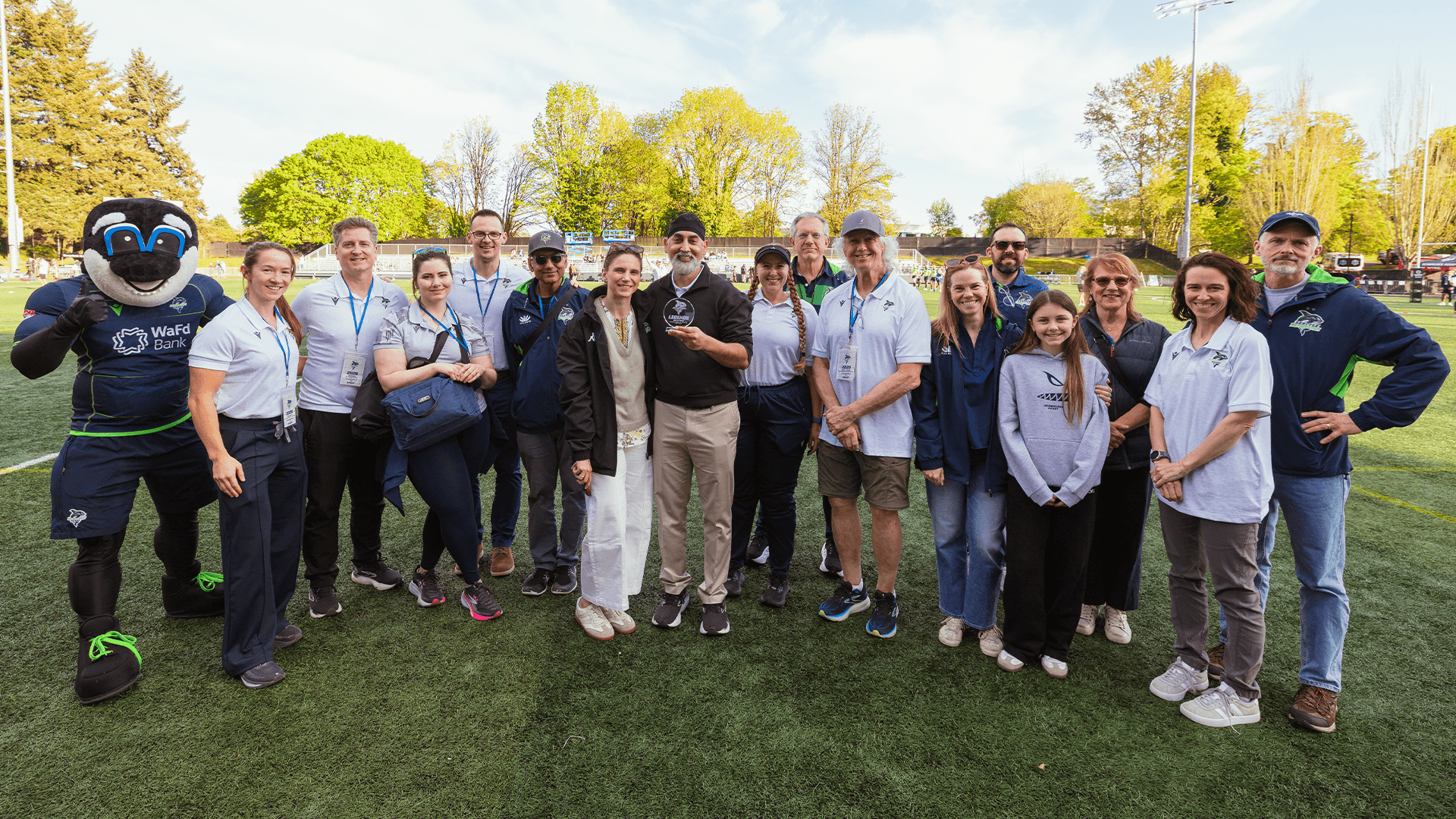
Dr. Virtaj Singh: The Seawolves Legend You Hope Never Has to Work
Every successful team has people fans immediately recognize. Players scoring tries. Coaches on the sideline. Leaders lifting trophies.
Then there are those whose best work goes unnoticed.
For the Seattle Seawolves, Dr. Virtaj Singh has been one of those steady figures since the club's earliest days. As medical director, he has helped care for players, built and organized a wide-ranging medical team, and guided athletes through one of rugby's toughest realities: the toll the game takes on the body.
His role is vital. It is also, in his own words, one where success can look like him not working.
“The goal would be to never have to interact with the players at all, because none of them are injured,” he said.
That line captures both his sense of humor and the nature of the job. If everything goes perfectly, the doctor stays in the background. In rugby, however, that rarely happens.
Singh has been with the Seawolves since the organization's founding in 2018. Before that, his sports medicine experience was built around high school football and community events. When the club was first assembling its roster of players arriving from around the world, there was an immediate need for medical evaluations and clearances. A friend knew the team's owner, and Singh got the call. He expected it to be a one-time assignment.
"I thought that was initially going to be all I did," he says. "But after that, they kept me on, and I've been here ever since."
What started as a favor became a founding role. Singh became the first medical director in Seawolves history and has held that position through every season since. Through playoff pushes, championship runs, and the relentless weekly demands of a collision sport, he’s been there, helping keep the team safe and healthy.
Singh's primary focus as a clinician is neurospine — spinal and brain injuries — which makes him particularly well suited to a sport like ours. But he’s quick to point out that no single person carries this load alone.
"The medical team is huge," he says. "Athletic trainers, physical therapists, chiropractors, massage therapists, medical doctors, across the board. It takes a village to take care of this team."
Day to day, the athletic trainers and physical therapists manage most of the work. Singh's involvement increases in the lead-up to game days and in the aftermath of injuries. The system is built on trust, communication, and everyone doing their part. Which, he notes, isn't so different from rugby itself.
Professional rugby players ask a great deal of their bodies. Repeated collisions, hard ground, awkward landings, impacts that would make most people reconsider their hobbies. Singh has seen it all. He has deep respect for the athletes he works with, even if their motivations remain somewhat foreign to him.
"They're in a completely different class of human than I am," he says with a laugh.
Over time, though, he's come to understand something deeper about these players. The contact isn't just tolerated. For many of them, it's the point.
"The contact from sport actually does something for a lot of these players, which I'll never be able to relate to. But it's impressive what they can put their bodies through."
That understanding shapes how he approaches care. He isn't there to change who they are. He's there to evaluate injuries, offer guidance, and help them be the best versions of themselves possible.
The injury list across eight seasons has been extensive. Broken noses, broken faces, head injuries, dislocated joints, and at least one occasion involving a pellet lodged in a player's ear. As Singh puts it, the Seawolves medical team has dealt with everything from toe to brain.
Before joining the Seawolves, Singh wasn't a rugby person. Football and soccer were his sports. In hindsight, the crossover might have seemed obvious.
"Rugby basically brings those two worlds together," he says.
But it wasn't until he started caring for the players that he genuinely embraced the sport and its community. What won him over was the game, yes, but also the culture around it. The respect for officials. The tradition of sharing a beer with your opponents after the match. The way the sport holds toughness and humility in the same hand.
"I love the environment surrounding rugby," he says. "It's different from other sports. Now that I'm into it, I really like it, even though I probably will never make it onto the pitch myself."
For all its old traditions, rugby has also embraced modern sports science. One development Singh is particularly enthusiastic about is the instrumented mouthguard: a device worn by players that measures head acceleration during impacts. If a significant force event occurs, the medical staff receives an alert and can pull the player for evaluation, even if no obvious symptoms are present.
"It allows an objective ability to pull a player and assess them without them necessarily having obviously had a head injury," he explains.
The system isn't perfect. It sometimes flags players who turn out to be fine. But it also catches incidents that might otherwise go unnoticed — and in a sport where head injuries carry serious long-term consequences, that’s important.
For Singh, it reflects something he genuinely appreciates about where rugby is headed. The game takes player welfare seriously, invests in understanding it, and has built clear protocols around returning athletes to play safely.
The Legend Behind the Scenes
When fans think of Seawolves legends, they think of championship captains, crowd favorites, and players who delivered when it mattered most. Those names deserve celebration.
But great clubs are also built by people whose contributions happen away from the spotlight.
Since day one, Dr. Virtaj Singh has helped protect the health of Seawolves players and supported a professional standard behind the scenes. He has brought calm to chaotic moments, expertise to difficult decisions, and humility to an essential role.
Eight years in, the players who suited up for the Seawolves did so knowing someone had their back. That's Dr. Virtaj Singh — and that's exactly what a legend looks like.
Dr. Virtaj Singh will be honored as a Seattle Seawolves Legend during the 2026 season.