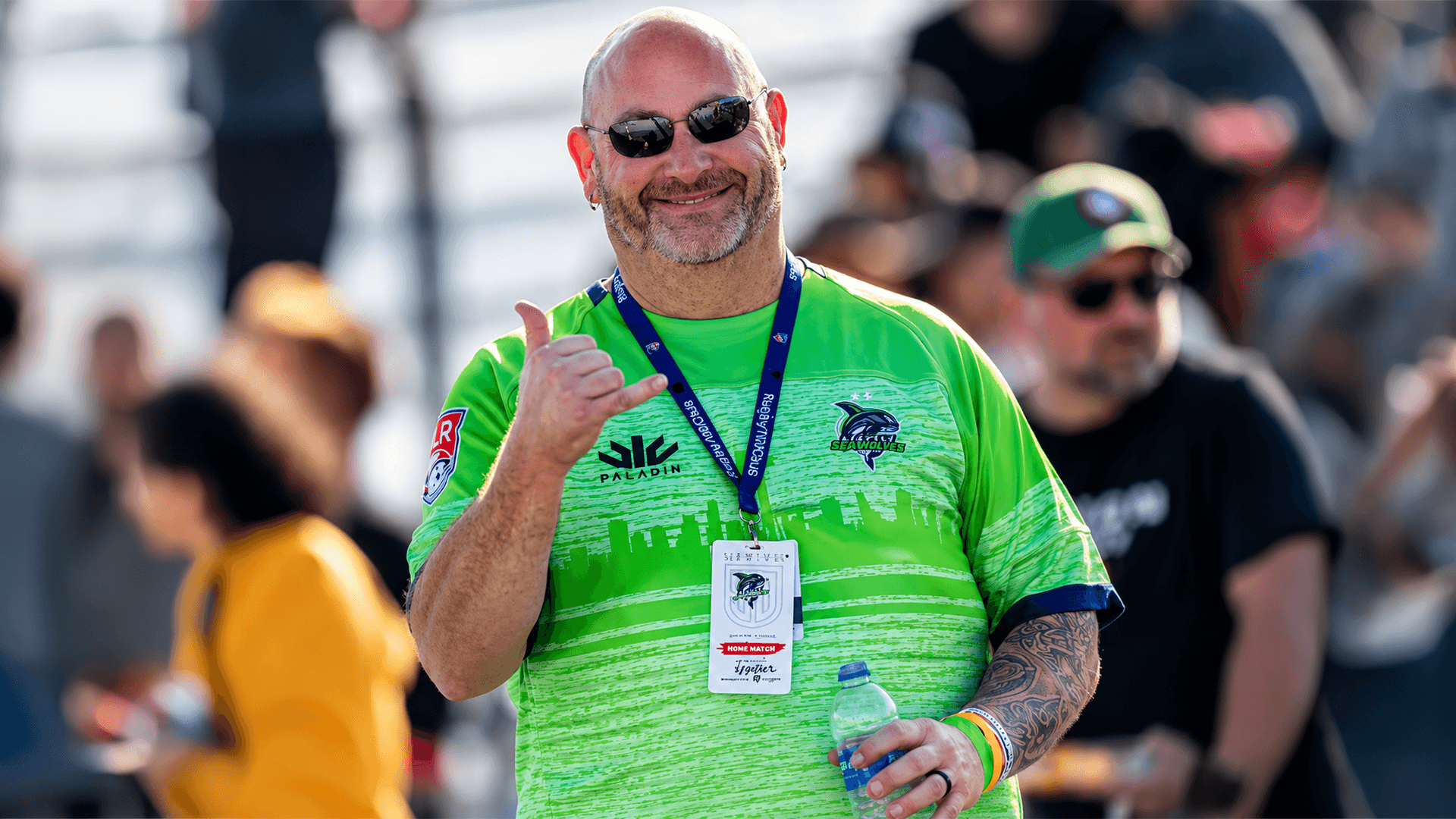
There are rugby fans. There are dedicated rugby fans. And then there is Matt Courtright.
A Seattle-area native and season ticket holder since the Seawolves' very first game in 2018, Courtright has attended more Major League Rugby matches than even many players. He is closing in on his 100th MLR game, a milestone he'll hit at the Semi-Finals this week in Seattle, and subsequently reach 101 at the Championship in Chicago.
Courtright has traveled to away games across the country, hosted fan gatherings in cities where he didn’t know a soul, organized billets for visiting youth teams, and built friendships with coaches, owners, players, and fans from every club in the league.
He does all of this as a fan. No official title, just an unshakeable love for the rugby community.
“Being a Major League Rugby and Seattle Seawolves fan is about more than supporting a team,” he says. “It's about community, belonging, and investing in the growth of a sport that changes lives. …[It] means believing in the future of rugby in North America and showing up year after year to help build that future.”
Courtright came to rugby the way a lot of American parents do: through his kid. His son fell in love with the sport first, partly because his dad didn't know enough about it to critique him from the sideline. That suited Courtright just fine.
“I can't coach it," he says. “But I can cook and I can volunteer.”
That became his entry point. In youth rugby, the home team hosts a social after every match as a chance for both sides to come together after competing. Courtright showed up to one of those socials and felt something click.
“Rugby is the closest thing I know to a set of values without having to say it out loud” he says. “On the pitch, you're fighting with rules. Afterwards, you got it out of your system. You can all be friends again.”
That philosophy of competing hard, then coming together became the lens through which he saw everything about the sport. It also became the thing he's spent the better part of a decade trying to share with anyone who will listen.
When Major League Rugby launched in 2018, Courtright and his wife Jennifer were among the first to buy season tickets. In 2019, they started traveling to away games. When Seattle made the championship run, they followed. Then the pandemic hit, the season shut down five games in, and Courtright spent the downtime waiting for rugby to come back.
It did. And so did he, with more tickets, more trips, and more people in tow.
“I bought 20 tickets to four different games and took everybody and their sister,” he says. “Just trying to expose the culture.”
By 2022, Jennifer had left her job so the two could travel together full time during the season. They attended every single Seawolves game that year — 22 matches in 24 weeks, including two preseason games and a championship run to Newark, New Jersey. They have been to every MLR Championship since 2019, with only 2018 and 2021 as exceptions.
Jennifer is not a reluctant passenger in any of this. Courtright calls her his queen, and she has been his equal partner every step of the way. Together they built something that functions like a traveling fan community: organizing gatherings in away cities, booking tables at postgame socials, and bringing rugby people together wherever the game takes them.
Courtright's involvement has never been limited to the professional game. From early on, he showed up to fundraisers for clubs he wasn't affiliated with, supported youth programs, and modeled the kind of cross-club inclusion he believes the sport depends on.
“Without opponents, we have nobody to play,” he says. “One club is great, but more clubs means we have a community instead of a village.”
He also helped introduce billeting to local youth rugby, hosting visiting teams from overseas the way families host foreign exchange students. The first team he hosted came from Whakatan, New Zealand. That connection eventually led to his son traveling to New Zealand after high school graduation, spending three and a half weeks there and coming home, as his father describes it, with a different attitude and a stronger sense of himself.
He coached youth players too; fewer tactics, more accountability. The mean uncle for two minutes when needed, then back to having fun. Some of those kids are now professionals. One of them called him late on a recent night just to talk rugby.
“It's all about the kids,” he says. “Then they become us.”
There is no cleaner illustration of how far Courtright's rugby relationships have gone than this: Seawolves head coach Clark and his wife Meredith got married in Northern Ireland and invited Matt and Jennifer. They flew over and found themselves among 60 guests, as the only Americans on the groom's side of the room.
Courtright spent the evening at a table with Adrian Balfour and his wife, a couple of coaches and their partners, watching two people he knew through rugby get married on their home turf. The party ran for ten straight hours.
A man who showed up to a youth rugby cookout in Seattle in 2016 knowing nothing about the sport ended up at his coach's wedding in Northern Ireland less than a decade later. That is what rugby does to people.
In late 2023, Courtright was diagnosed with CIDP, a neurological disorder that left both sides of his face unable to move. He lost 30 pounds in weeks because he couldn't keep food in his mouth, and went from being the most mobile rugby fan in the country to walking with a walker.
He kept going to games.
“I'll go through the airport with a walker if I have to,” he says.
What struck him during that period wasn't just his own determination. It was the response from the community. People checked in, coaches reached out, fans from other clubs sent messages. For someone who had spent years investing in rugby's culture, it came back when he needed it most.
“That'll make a grown-up cry every time,” he says.
The experience deepened his connection to the sport rather than diminishing it. He kept attending games, kept organizing gatherings, and started putting the stories into a podcast.
“When I started The Rugby 100 Club, my goal wasn't simply to create another rugby podcast,” Courtright says. “I wanted to tell the stories that connect supporters, players, coaches, and communities. I wanted to document the people who are building the game and create a platform where their voices could be heard.”
Over the years it has grown into a running record of professional rugby's growth in North America and a place where fans can feel connected to the game beyond match day. Traveling to matches is central to the mission; every stadium has its own stories and every city has a rugby community that doesn't always get seen.
His vision for rugby in America is specific. The sport has a marketing problem, he'll tell you plainly. It gets brought over from overseas without being translated for an American audience — the rules, the terminology, the culture. None of it is intuitive if nobody explains it.
Courtright explains it. Constantly, enthusiastically, and in terms that make it land.
“You have to communicate it to Americans,” he says. “Once it clicks, it clicks. And then they're in.”
In rugby, earning 100 caps is one of the highest honors a player can achieve. It represents years of commitment, consistency, loyalty, and sacrifice. Across the entire history of Major League Rugby, fewer than a handful of players have reached that milestone.
Matt Courtright is about to reach it as a fan.
“The '100' in Rugby 100 Club carries special meaning,” he says. “Those same values — commitment, consistency, loyalty, sacrifice — are at the heart of what we do. The name reflects a commitment to showing up, supporting the game, and contributing to rugby's growth for the long haul.”
This weekend in Seattle, he'll log game number 100. Jennifer will be there. He'll find the nearest table, fill it with rugby people, and make sure everyone feels welcome, because that is what he has always done.
A parent who showed up to a youth cookout in 2016 with no knowledge of the sport and no particular reason to stay has become one of its most dedicated ambassadors. He earned that the same way players earn their caps: one match at a time, year after year, never missing a chance to show up.
Matt Courtright is the founder of Rugby 100 Club. Follow his coverage of Major League Rugby and the Seattle Seawolves wherever you listen to your podcasts.